Showing posts with label Super Famicom. Show all posts

Monday, December 15, 2014

Breaking Bad


As a retrogamer, it should come as no surprise to anyone that reads this blog that I am not a spring chicken. Today another birthday rolled around, and while the usual childlike glee of a day that belongs solely to me was foremost on my mind, the ticking of my ever-present biological clock was echoing loudly in my ear. It sounded remarkably like: ‘Congratulations, Sara, you are OLD.’ Given my love of self-mockery, this quickly turned into a desire to write something about my ludicrous personal struggles for this blog. It’s amazing what aging can do for writer’s block.

The topic that came to mind was one that is near and dear to my heart: How the aging process changes a gamer’s innate ability to succeed at their chosen hobby. Most of us are familiar with this particular brand of suffering, I think. The rude awakening of picking up of a favorite cartridge that you used to be able to beat in one sitting as a child, only to find that as an adult you have trouble with the first world is something that many of us have had to face. Whether you blame it on aging or on the blatant handholding of modern games, many gamers that I have talked to over the past few years have faced this very problem. To pick up a game that I had beaten as a child without losing a life and realize that I had, in fact, become bad at it, was a realization both horrible and humbling. I blamed everything under the sun, from an uncomfortable controller to aging reflexes, before coming to the conclusion that I have since reluctantly embraced. I was the problem.

As I child, I spent many hours at my aunt’s house, and while the adults gabbed, I would be holed up in her basement with my cousins’ Atari 2600. I have mentioned this much loved console in previous posts, I know, and the impact that it had on my life cannot be overstated. While I’ve played many games for that system over the years, my favorite was most definitely Frogger. The love I had for that game was almost inexplicable in its intensity. My parents should be thankful that they never loosed me anywhere near the arcade version, as we might still be there today.


I still loathe that alligator.
For a game that was basically about getting a frog across a road or other obstacle safely, the fact that I still think of it so fondly is startling. I took that little frog’s mission personally, and every failure to get him safely home was almost crushing to my sense of justice. Therefore I would sit in my aunt’s basement for hours, the Atari 2600’s simplistic joystick cutting into my hand, playing through the same levels over and over again because ‘That gator isn’t going to get me again!!!’ Where I got that sort of patience, I have no idea. Where it went, I wish I knew. I honestly believe that if I still possessed that particular quality today, I could take on any game that I wanted to and win.

Perhaps if I am able to find a bit of that intense focus that I possessed as a small child, my ability to game at a higher level will slowly return. It is certainly an experiment that I’m willing to undertake. I must admit that I miss beating Nintendo platforming classics in one sitting, and I certainly miss bragging about it. There is no gamer credit to be had in the fact that you were able to do something twenty years ago, after all! While the more cerebral games that I moved on to later in life have been satisfying to me, I will not deny that I envy others the quick twitch reflexes that I lost which were necessary for success in my favorite games back in the day. Perhaps it’s not too late after all?

This bit of nonsense has been motivating for me, if nothing else. As previously stated, this post was a small exercise in amusement for me for my natal day which I hope that you enjoyed. With luck, I’ll be able to bring you something more worthwhile soon. Until then, I hope that your skills stay sharper than mine!


If you feel like hearing more of my gaming prattle, feel free to follow me on Twitter. You can find me at @bejiita_buruma

Friday, August 29, 2014

Cartridge 5: Elfaria (エルファリア)


Name: Elfaria (エルファリア)
Type: Fantasy RPG
Available Languages: Japanese

Today’s blog post is going to be an interesting one, if only because it is going to be a bit different from the norm. The game that I’m looking at, Elfaria, was a game recommended to me by my friend Julian Hill over at the excellent SNES blog Boxed Pixels. We decided to both go into this game cold, me being able to read Japanese and him not, to see what each of us got out of it. So if you haven’t had a chance yet, make sure you head over to his blog to check out his post on Elfaria when you’re done with this one. It’s sure to be a very different take than mine. With that said, it’s time to take a gander at another Super Famicom RPG.

So apparently this is the story of Elfaria, the land that has been blessed by Ra. After reaching the start screen, you can wait to watch a rather interesting cut scene, which shows both character introductions and gameplay hints. After doing that, it’s time to start the game proper. A cut scene occurs, which informs us that a long, long time in the past there was a kingdom of elves. The elves controlled the ‘power of Ra’ that built up in their holy land the ‘spring of Ra’. ‘Ra’ is the source of life and magical power. Far, far in the past there was an era called the ‘Magic War’. Elves and people were in conflict, the ‘spring of Ra’ dried up, and the land fell into ruin.


The elf elder meets up with a woman called Eruru. He has had a bad dream about the destruction of the world. Someone was using the power of something or someone called Eruza-do. The scene switches to a castle, where King Jyozeru states that General Shi-raru has begun a coup d’état in Mu-rania. Jyozeru says that Elfaria will save Mu-rania and sends Darugan to handle it. On the battlefield while fighting the monsters, General Darugan performs a face heel turn and attacks his former allies. He says that the era of Elfaria has come to an end and that the era of Mu-rania is beginning. The remaining soldiers run off, realizing that the general has betrayed them. A few more scenes flash by, and the game informs us that fifteen years have passed. We have reached the in game title screen: A Fantastic Theater Elfaria the Isle of the Blest.

We are introduced to what are clearly our antagonists, who are led by Shi-raru, an ax wielding giant who could squish anyone else on the screen like bugs. The traitor Darugan is at his side. Shi-raru is in the midst of sending out his grunts to take control of places called Foresuchina and Kana-na. One of Shi-raru’s underlings, Zo-ra, is exchanging items called the ‘symbol of water’ and the ‘symbol of fire’. This will make the Ra in the water country of Kana-na become chaotic and cause the country to overflow with monsters.

We finally catch up with the main character, Pain, who is reading a large tablet. It tells him not to throw Ra out of order lest monsters be born, the land die, and the world be destroyed. It appears that this is an ancient legend in Elfaria and that it is possibly coming to pass now. Pain, being the hero, wants to do something about it. Music starts playing, distracting him from his musings. He is confronted by the strange woman that we got several glimpses of in the opening sequence, accompanied by her critter companion. She knows who Pain is, but he doesn’t know her at all. If you recall, her name is Eruru, and apparently she’s been waiting a long time for this day. She tells Pain that it’s time for him to go on a journey to gather the four symbols. Pain is rather startled the he is the one who is needed to collect the symbols of the holy land, but he seems prepared to roll with it. As we already know from the opening sequence, the symbols are being switched around in order to mess with the natural flow of things in the world, so we need to fix this as soon as possible. Stopping this will staunch the flow of monsters, which can only be a good thing. Eruru gives Pain an elf orb called the ‘Blue Gem’. It can be used to calm the ‘holy land of water’. She says that the four symbols will surely give power to you and your future allies as well. Eruru tells you to do your best and then tells Papi, the little pink creature that accompanies her, that it’s time to leave. Knowing no more about this strange woman than we did before, she leaves.


Pain returns home, where we meet Razeru. She knows that he has been to the elven monument again, which seems rather obsessive of Pain to me. Heroes. Considering that there are monsters in the village nearby, Razeru finds Pain’s excursions rather dangerous. Pain ignores her and addresses the man with the epic hair who is also in the room. This is Professor Uppara-. He shows him the elf orb, which Uppara- is way too hyper about. When Pain tells the professor that he got the orb from a girl, Razeru is not amused. Ignoring her yet again, Pain tells Uppara- that he is going on a journey. The professor decides to join him, as it has been a while since he has used his magic. Razeru decides to go too, because she can use magic, and because she’s worried about Uppara-. I’m sure Pain doesn’t factor into her decision at all. As if by magic, a swordsman named Ji-n shows up at the door looking for Pain. He works for the king of Kana-na, and has heard that Pain has been investigating a way to fight the monsters from the people in the village. Wow, word travels fast in these parts. It appears that the king of Kana-na ran to the village next to this one and was captured. It looks like Ji-n needs Pain’s help to rescue him. So with that, Pain begins his journey, and with a full party no less!

This game is certainly different from your average turn-based RPG fare. You don’t gain experience or money from battles, and only level up at boss fights. You do, however, get equipment not only from chests, but from item drops in random encounters. You can meld different weapons, armor, and items to one of five slots in each character’s melding menu in order to raise their stats.

The battles play out mostly automatically, with the commands at the bottom of the screen depending entirely on your party members. Your original party commands consist of Off, Dwn, Luk, and Ice. Off turns off your magic. Dwn is a stat lowering spell that can be used against your enemies. Luk is a stat raising spell that can be used on your party members. Ice is an offensive spell. Party members also have other abilities. Razeru, for example, is a good healer. The only control you have during battle is moving your cursor over one of these four commands in order to direct the game towards which spell you would prefer for the characters to use and hope for the best. I’ve read that A button mashing will speed up spell use, but I haven’t personally found this to be the case. It seems to me that it is really up to the AI in the end, unfortunately.

The character designs are extremely interesting, if you like really stylized visuals. If memory serves, they are what drew Julian to the game originally and they are unique enough that I knew immediately what game he was talking about even though I had never played it. Some of the music is rather nice, I must admit, until you’ve been listening to it on loop for several hours. In the cut scene that runs off of the start menu, when you see a skeleton of kaijyuu proportions being attacked, the old-school music brought a broad grin to my face. Call me a colossal nerd if you like (you’d be right), but I liked it. The game itself doesn’t look horrendous, with detailed sprites and bright colors, but if you’re looking for eye candy, this isn’t the game for you. The mapping is quite bad, to be honest. I’ve seen better work done by amateurs on RPG Tsukuru. To quote Julian, “The villages look shocking.” Considering the amount of time that you spend in towns in this game, that’s quite a problem.

To be honest, this game is way too random for me. The melding system aside, I still feel like I have little control over the outcome of the battles. I’m an RPG gamer, which means that I thrive on control. Therefore, random encounters quickly become an exercise in pain for me, particularly if I don’t get a decent item drop afterwards. I quickly decided that Julian and I were on the same page in regards to Elfaria, his opinions of the game quickly moving from “Shoddy shoddy shoddy.” to “I have demoted it from ‘okay’ to pretty terrible.” to “How did enough people buy this to justify a sequel!?” All the hope for this game was quickly gone. The thought of someone playing Elfaria as their first JRPG, let alone using it to judge an entire genre, terrifies me. As this is a joint post, I will quote Julian yet again by saying, “‘Elfaria’ would not be considered the game to persuade Westerners that JRPGs are accessible, exciting and beautiful. Even with an English fan translation, I doubt that this game would ever be the adventure of choice for a player who had access to anything Square or Enix published in the 16 bit era.” Truer words were never spoken. So in closing, while I relish the experience of playing something different from the norm, and talking about it with a good friend of mine, I must admit that I can only recommend Elfaria to the most patient and stalwart of gamers. Scratch that, I really can’t recommend it to anybody.

If you feel like hearing more of my gaming prattle, feel free to follow me on Twitter. You can find me at @bejiita_buruma

Thursday, July 17, 2014

Cartridge 4: Cyber Knight (サイバーナイト)


Name: Cyber Knight (サイバーナイト)
Type: Sci-Fi RPG
Available Languages: Japanese

I’ve been on a space kick recently, it seems, particularly after playing Alshark several weeks back. Between that and Gadyurin, this blog has seen a bit of interstellar travel, but there is room for more, in my opinion. A part of me wanted to dig out my copy of Phantasy Star: Sennenki No Owari Ni so that I could do homage to its greatness, but the truth of the matter is that that game is way too famous for this blog. So with my usual admonition of ‘go play that if you haven’t yet’, I’ll move on to something else. In keeping with my current mood, I’ve decided that that something else is going to be the Super Famicom JRPG Cyber Knight.

After starting the game, naming my character, and distributing six points as I will in his stats, the game itself begins. A spaceship, the Swordfish, is being attacked by pirates, and one of their lasers has hit the main engine. I may not be a futuristic spaceship mechanic, but even I know that that means trouble. Soon, pretty much everything is shutting down from massive damage, and the captain is out of commission. There is nothing left for the crew to do but to use the Jump Drive without a known destination, which is just about as dangerous as it sounds. It’s either that or die here for certain, though, so the commander (that’s you) chances it.


A long time ago in a galaxy far, far away....

After your wild space ride, the remaining crew lands on an unknown planet with their ship damaged, unable to use the Jump Drive to take them back to Earth. So, there is nothing to do but land your spaceship and, with the five other combat ready crew members available, take a look around the planet we’re on. After trotting through the various rooms on the spaceship to familiarize ourselves with them, it’s time to head to the hangar and find our Modules, which are giant fighting robots. This game just got way better, didn’t it? After choosing which three party members get to have all the combat glory, it’s time to move out. Unfortunately, they’re puny little level ones, so we have no recourse but to level grind.

Luckily, our ship has landed right next to a city populated by humans whose speech we can understand. What are the chances? Apparently this planet is called Far World by the people who inhabit it, which is a useful (and rather strange) bit of information. So after shrugging at the naming sense of the locals, our intrepid heroes learn that there is a college nearby which may be able to help us out of our predicament. There we meet Professor Sokolov, who says that the humans on Far World left Earth 250 years earlier on the immigration ship Europa. It appears that they ended up here as a result of a jump miss, much like us. It seems that whatever remains of the Europa is in the forest to the north, so we should probably go check that out for the Monopo-ru Coil, which is the part we need. After getting a bit more helpful information and a star map from the local scholar, we have to go talk to the President of Far World. It sounds like he’d be a good person to know.

After getting hassled by the President’s surly guards, we meet President Roland. After confirming that Far World is populated by Earthlings who made an emergency landing here 250 years ago, he apologizes to our party. It seems that we were mistaken for invader robots which have been hassling the locals as of late. It sounds like they need us to take care of this problem for them, even though there are only a handful of us. We do have giant robots of our own, after all. But what about our Monopo-ru Coil, you ask? We’re certainly not going anywhere without that, so we’ll take the path that makes the most sense at the moment. We’ll head to the Europa in the forest to the north, and hope that some of these local robots are stupid enough to try to get in between us and the shiny part that we need. Now that sounds like a plan!


A map of the Swordfish, your sweet, but currently useless, ride.
In battle, your screen will be split into three sections. The upper right section displays your stats and the bottom section gives you information about the battle as it is happening. The upper left section shows the battle itself, with your three Modules on the right and your enemies on the left. When it’s your turn, you get a list of options to choose from. You can attack, defend yourself or others, or use the option menu to use items like rocket launchers or missiles. In the equipment menu, you can change your weapons or use defensive field items. You have the option to continue battling or run if you press the B button.

The game really doesn’t look like much, I must admit, but I’m willing to give it a bit of a break given that it was released in 1992 and that its PC Engine counterpart dates back to 1990. The game’s best moment, appearance wise, is in battle, when the Modules and their enemies attack each other. While these little cut scenes can be quite tedious after a while if you’re trying to level grind, they look quite a bit nicer than the rest of the game. The music isn’t bad at all, given the game’s age. It’s rather generic, but certainly acceptable.

I must admit to getting quite bored with Cyber Knight after a while. I feel rather badly about it, given that I liked the premise. But the battle system lags so much that after a while you feel like you’ve been waiting for years to get from one place to another. While those cut scenes that I mentioned earlier are the nicest looking part of the game, they are also the most frustrating part. Every attack is played out that way, not just special attacks, and it takes every bit as long as you would think. If you are a fan of space based RPGs and have a lot of patience, Cyber Night is worth a look, but if you have another game on your docket you may want to weigh your options.


If you feel like hearing more of my gaming prattle, feel free to follow me on Twitter. You can find me at @bejiita_buruma

Thursday, May 8, 2014

Cartridge 3: Eien No Filerna (永遠のフィレーナ)


Name: Eien No Filerna (永遠のフィレーナ)
Type: Fantasy RPG
Available Languages: Japanese

Today we take yet another jaunt down 16-bit memory lane. I found myself at a bit of a loss as to what to write after my last post’s dating sim rant and decided that it was time to return to the Super Famicom for a while. We are once again looking at a game that I have no previous knowledge of, which was chosen purely because the box art intrigued me. Eien No Filerna (Eternal Filerna), the game which I am prodding with a stick today, appears to have been based on a series of Japanese light novels and anime. We’ve seen this before, I believe. So after shaking off the dregs of inactivity, it’s once more into the breach!

After getting the usual scrolling bit of backstory text common to games of this era, we dive right into the game proper. You begin this game as the titular character Filerna (which is how I shall spell her name, as that is how she writes it on her diary), a young woman who, according to the accompanying manual, is masquerading as a man. She is a slave from the ocean country Firosera known as a Kurechia, who is forced to be a Battler for the entertainment of the empire Debisu. After being given a bit more backstory on the Battle Show that the empire is so fond of, Filerna, age six, is thrown into a training battle against a man named Zena. Apparently Filerna has no choice but to train to prepare for life as a Battler among the men, so it’s time for this little girl (and us) to grow stronger.

After some more background information on Battlers, whose lives sound about as miserable as you would expect, we find that ten years have passed. As Filerna is now old enough to become a Battler in truth, she faces one last training battle against Zena, and this time we’re at the controls. After a fight in which neither opponent does much in the way of damage to one another, Zena gives Filerna some last minute advice, as her debut is tomorrow. He then gives us some equipment to make our survival more likely, accompanied by a tutorial on weapons and armor. Zena then tells Filerna that he has trained her because she has an important mission, which is exactly what she needs to be discussing the night before her first gladiatorial battle, when she should be more concerned with her impending doom. He then shoos Filerna off without another word, telling her to rest. I’m sure she’ll be able to sleep wonderfully, given that she has no pressure on her or anything.


Filerna makes some new 'friends'.
Now that we are free to roam around, we can enter the menu proper. There, we can see that Filerna is most certainly too pretty to fool anyone into thinking that she is anything other than a sixteen year old girl. After seeing that Zena’s lovely new equipment is indeed set, it’s time to rest. After lying in bed for all of two seconds, Filerna gets up and is called before the imperial commander who is in charge of the Battle Show that we are to be a part of. It seems that he has brought all of the Battlers who are to take part in tomorrow’s fight before him so that they can survey one another before they try to commit murder for entertainment. There are no words. What follows is an exercise in posturing, during which all of your potential opponents tell you exactly how they intend to kill you. Then the commander calls in a bunch of women and offers them up to the Battlers. I repeat, there are no words.

Filerna has the taste and the sense to leave her companion for the evening behind. She returns to her room to rest. Unfortunately Rira, the girl in question, doesn’t seem to be able to take a hint. She walks right through the door and begs Filerna to have sex with her. Wow. Filerna’s reaction is much like mine, a long line of ellipses. It seems that Rira is so set on them sleeping together because it is her duty, and that something bad will happen to her if they don’t. I repeat, wow. Whatever Filerna’s plan is to take down the empire, I’m on board one hundred percent. Filerna tries to worm her way out of the situation as nicely as possible, but the inevitable happens and Rira loses her temper. After calming her down by complimenting her beauty and saying that she can sleep in her bed, they turn in for the night. Rira awakens Filerna with a scream and a hilarious bug-eyed animation as she realizes that her companion is a girl. Filerna tells Rira that she has been raised from birth as a boy, although she doesn’t know why. Poor Rira tells Filerna that she was raised from birth in preparation to sleep with men. So after another bizarre and awkward conversation, Rira agrees to keep quiet about Filerna being a girl and a friendship is formed. Being a Kurechia is quite possibly one of the most awful things I’ve run across in videogames in quite a while.

Rira discovers that Filerna is a bit more...er...top-heavy than she originally expected.
The next day the commander comes to collect Filerna and, when asked about Rira, he tells her she’ll find out if she lives. Thanks for nothing. Since there is no putting this off, Filerna allows herself to be escorted to the arena with the other Battlers. A priest comes out, babbles about how the Battlers have the courage to offer up their lives, and calls upon Debisu’s god for them. Because clearly being a Kurechia is a completely voluntary vocation, from what we’ve seen so far. Now it’s time to get this show on the road. Filerna’s first fight is against a Battler named Big Elephant, whose armor clearly gave him his nickname. The fight is quite easy, and while I take no pleasure in this particular victory, the announcer’s surprise at Filerna’s survival is rather offensive. Filerna passes out soon after winning and awakens in a nicely appointed room, where Rira awaits us. It seems that this is Filerna’s new house, which she will get to keep for as long as she remains breathing, and that Rira has taken up the mantle of Filerna’s wife. Nice cover. Now if only Zena had told Filerna more about this supposed mission of hers. You’ll just have to play the game to find out!


Rira decides that she and Filerna should pretend to be a couple, even though she thinks it's a bit perverted.
The game’s combat system is simple enough. You can have up to four characters in your party during battle. There is a gauge next to each of the character’s names, and when that gauge fills, it is your turn. A collection of four icons appears above your character’s head when it is that character’s turn. You have the option to attack, defend, use items, or run. Where it gets interesting is that when you attack, instead of using a simple offensive tactic, you are ushered into a stock menu. Here, you are shown the weapon that you possess and the special techniques that it is capable of. You can stock up to three different weapons and items, including healing items, making for some very interesting tactical planning.


I can’t say very many positive things about this game on the appearance front, though. The game looks rather average overall, which they had absolutely no excuse for with what the competition was able to produce in 1995. Your tiny sprites stare up at giant enemies in the classic format, but other than several interesting enemy designs, there isn’t much to write home about here. Some of the major rooms are decently accented, as you can see that some thought was put into making them look lived in, but that is certainly not consistent throughout the game. The music is neither good nor bad, made up of the kind of tunes of the era that you filter through your brain without really listening to them, but that you don’t dislike enough that they become repetitive. I wish that I could find something stellar in this game’s design to point out to make up for accusing it of being somewhat underwhelming, but if such a thing exists, I haven’t found it.

In the end, Eien No Filerna felt like a rollercoaster ride between greatness and mediocrity. The story was interesting and the battle system was innovative, and yet the music was dead in the water and the appearance of the game was occasionally lacking. This game has so much to offer and yet it will be overlooked by many wholly on its lack of flashy graphics and memorable music. It really is a shame, as I actually really like this game and hope that people will play it regardless of its flaws. There is a lot of amusement to be found playing Eien No Filerna if you’re willing to look for it.


If you feel like hearing more of my gaming prattle, feel free to follow me on Twitter. You can find me at @bejiita_buruma

Thursday, March 20, 2014

Cartridge 2: Gadyurin, AKA Gdleen (ガデュリン)


Name: Gadyurin (ガデュリン)
Type: Science Fiction RPG
Available Languages: Japanese

Ladies and gentlemen, once again we visit the Super Famicom! Today’s game came to me entirely by coincidence. During a conversation with a fellow retro gamer and friend who loves the SNES, I was asked a question that I had no answer to. “What do you think of Gdleen?” To my intense embarrassment, I had never played it, even though it has the distinction of being the first Super Famicom RPG. This needed to be rectified, both to answer my friend’s question and to soothe my bruised ego. So three days later and six dollars lighter, I found myself in possession of a slightly used ‘Gadyurin’ cartridge. I will be calling it Gadyurin from here on out, because Gadyurin is the name on the cartridge and ‘Gdleen’ just looks strange to me. From the bit of pre-game research that I’ve done, Gadyurin is based on an anime that is based on a series of light novels. Hopefully this doesn’t require any prior knowledge of the series, as I’m quite the fish out of water here. But RPGs are supposed to be an adventure, so let the fun commence!
We start the game as the hero Ryuu, who has just had the misfortune of crash-landing on a strange planet. Several websites tell me that his name is Ryu-n, but the game and the Japanese websites that I’ve looked at say Ryuu, so that’s what I’m going with. After removing himself from his escape pod, Ryuu grabs his gear, including a laser gun, and heads out to find a way back home to Earth. It appears that we have landed in a place called the Forest of Rurua, but as that information means nothing to me, I suppose that we should keep exploring. Thankfully, the pod will allow Ryuu to rest as needed, so the all-important level grind can now come into effect.
 
 
Once he is less likely to die, it’s time to take Ryuu onward through the forest, past a disturbingly still river, to the Water Shrine’s Ruins. There is a grave keeper here, and he’s as full of doom and gloom as you could wish. Apparently this place used to be a bastion of strength against monsters, but lately they’ve found their way inside. So let’s head right in! I want to find this Taranto boss monster that he sounds so frightened of. I’ve spent enough time shooting lasers at mooks. After catching up with the local humanoids and looting their stuff, Ryuu heads out to perform some amateur heroics. He really doesn’t have much of a choice, as Taranto is between us and our destination.
I’m surprised at how much this game holds your hand as you progress. There are healers everywhere, it seems. First the space pod, then two healers in quick succession in the shrine. Either they’re trying to lull me into a false sense of security, or this is one of the easiest JRPGs ever made. Given prior experience, I’m going with the former until proven wrong. Taranto, as the name indicates, is a giant spider. Anyone who knows me well is aware that I have a severe case of arachnophobia, so this thing has got to go. With big red eyes, eight spikey toed legs, and a methodically munching fanged maw, Taranto is 16 bit nightmare fuel. It hits surprisingly hard and can poison you, giving proof to my earlier claim that this game appeared to be way too easy.
 
Taranto in all his spindly nastiness.
 
Once Taranto has been squished, and the creepy crawly feeling has passed, it’s time to take Ryuu further through the bowels of the shrine. After passing yet another healer and leaving through a horribly ugly courtyard, we find ourselves on the other side of the disturbingly still river. Apparently we couldn’t just ford our way across it. After covering another section of the Forest of Rurua, we run across an even more disturbingly still waterfall and, after a bit of searching, find Fana’s Spring. There we run smack dab into a cut-scene with a naked girl with fairy wings, who turns toward the protagonist with the camera cutting away at the last moment to taunt the audience. It seems that she speaks a different language than Ryuu, but can use a ring that she possesses to communicate with him. Surprisingly, she seems to be perfectly find with being buck naked in front of a strange man, and even hugs him. Turns out she wants in on our little quest and so becomes our next party member who, coincidentally, bears the name Fana. Lucky you, Ryuu. So Ryuu’s journey through this strange world continues, and so far I am satisfied with it. After all, it’s not every day that I get to kill a giant spider with a laser.
 
Fana seems quite comfortable in her own skin.

The battle system is your classic first person view turn-based system, with options to attack, run, use items, use special attacks, and defend. What is interesting is that this game also has a command that allows you to talk to the enemy, during which you can use one of several options in order to try to win them over to your side. You can tempt them with items, gems, and gold, or try to coerce them with your words. It’s surprisingly complex.
This game looks much better than I had anticipated. I was frankly shocked at how nice the appearance was in comparison to several other games of this era that I have played. I don’t know whether that says more about Gadyurin or about the companies who didn’t utilize the Super Famicom’s potential as a system. It’s not a visual marvel in any sense, but it passes muster for 1991. That being said, the mapping in some scenes was rather uninspired, and the character’s slow gait made getting around feel like an eternity. But to balance that out, there were a few enemy designs, such as Nemuri Hime, that I absolutely adored. The cut-scene with Fana, all subtext aside, was nicely done as well. Some of the music in this game is really catchy too, and I found myself stopping to listen to it more than once. Gadyurin, like many games of its era, was written in furigana, so it’s a great game for beginning learners of Japanese to start out with.
When all is said and done, I like Gadyurin. It was worth the investment of time, and certainly was a good place to drop six bucks. I had, of course, heard of this game before, but probably wouldn’t have gotten around to it for years if it wasn’t for the mention given to it by my friend. While he goes unnamed in this post, I want to thank him for giving me the push, intentional or otherwise, to play this game. I’ve truly enjoyed it, and I hope that this in some way answers his question. My quest through Gadyurin will most certainly be continuing.
 
 
If you feel like hearing more of my gaming prattle, feel free to follow me on Twitter. You can find me at @bejiita_buruma


Thursday, March 6, 2014

Cartridge 1: Emerald Dragon (エメラルドドラゴン)


Name: Emerald Dragon (エメラルドドラゴン)
Type: Fantasy RPG
Available Languages: Japanese

I remember mentioning, back in the halcyon days when I started writing this blog, that I would not always be covering PlayStation games. Check the post Delusions Of Grandeur if you don’t believe me. This week, I feel the need to spend some time with my childhood sweetheart, Nintendo’s incomparable Super Family Computer, better known to many as the Super Nintendo Entertainment System. Since I’m still on a dragon kick from last week, what better way to showcase this classic system than with an RPG where the main character actually is a dragon? No, we’re not playing Breath of Fire. This week’s game is called Emerald Dragon. It was released on several different systems over the years, has some lovely artwork, and spawned its own set of drama CDs. I beat it years ago and have been looking for a reason to do so again, so here’s hoping it can amuse us for a while.

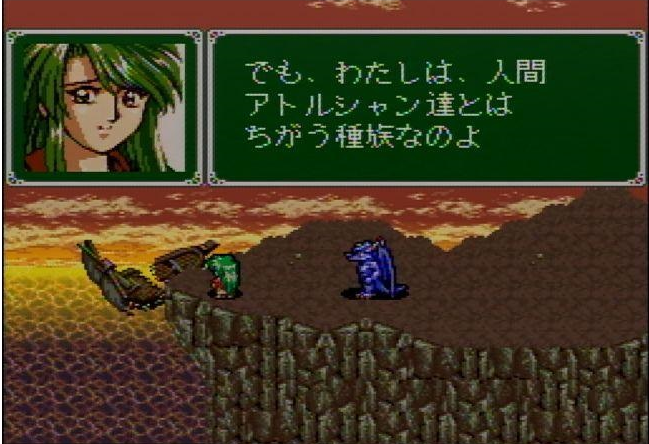
The game opens with a quick introduction to the primary characters, and then states the title rather intensely. A small amount of voice acting in a Super Famicom game? Nice! Moving forward, we are taken to Doraguria, home of the dragons, if you couldn’t guess by the name. It’s not a good day, though, as there has been a shipwreck nearby. Rather pleasantly, after last week’s extended wading through text, I gained control of a cute little blue dragon immediately. He is the main character and has, hands down, my favorite name of all time: Atorushan. Say that five times fast. The ship apparently belongs to humans, and the only survivor is an amnesiac girl. The white dragon, leader of all the dragons, appears and it is decided that the little girl will remain among them and be known as Tamurin.


Fifteen years pass, and it seems that Tamurin returned to Ishuba-n, where the humans dwell, three years ago. Now she’s calling via the horn that Atorushan broke off and gave to her. He told her to use it if she needed him to come and save her, so clearly something has gone wrong. Unfortunately, Ishuba-n is cursed land for dragons and going there would kill him, so clearly we have a problem. The white dragon gives Atorushan a key to a secret path, within which you can find the Silver Scale, an item that will protect you from the aforementioned curse. How convenient!

The first dungeon in the game is more of a test of your will than anything else. There is no experience or money to be had, just an endurance test. How much do you want to save Tamurin, Atorushan? Once you reach the altar where the Silver Scale rests, some happy music plays, and Atorushan is rather unceremoniously turned into a human. Oh well, I’ve played this game before, I knew it was too good to last. So, grabbing a few basic pieces of equipment and a small wad of cash, we’re off to the land of the humans to find Tamurin.


In the introductory sequence that follows, you can see that things are really as badly off in Ishuba-n as had been previously hinted. Looks like we had better get to tracking Tamurin down quickly. After arriving in the city of Uruwan, your search begins in earnest. Apparently there is an army, aptly called the Evil Army, that has been causing a bit of a stir around these parts recently and people are looking for brave souls willing to fight them. After talking with the village elder, who is ludicrously happy to see you, you are given a quest to rescue the sorcerer Bagin. Like every other RPG in the universe, nothing ever goes according to plan. But a ray of hope arises as he tells Atorushan that a girl named Tamurin went to the temple where Bagin is. What are the chances? RPG chances, of course! You are sent to the local bar to fetch Barusomu, a swordsman who will help you on your quest. Barusomu locates the secret entrance into the temple with disturbing ease, only to be stopped short on the way in by the smell of death. Great, this place is chock full of the undead. Have I ever mentioned that I hate zombies? After the battle is over, and being explicitly warned to be careful, Atorushan runs headlong into a trap. But, in the world of glorious RPG coincidences, it lands him in the same cell as Tamurin. Unfortunately, she has no idea who he is, being that he is in human form. With this inauspicious set of events, Atorushan’s journey across Ishuba-n to confront the forces of evil begins.
 
 
Unfortunately, the only character that you can control in battle is Atorushan. There is a blue bar at the top of the screen indicating how much energy you have to perform tasks, and once it is depleted, your turn is over. Moving decreases the bar, as does attacking. All you have to do is press the directional button toward the enemy that you want to attack and once you reach it, press toward it to attack. A box around your character shows how much room you have to move before your bar depletes and your turn is over. It really could not be simpler. The NPCs in your party all have their specializations as well. Tamurin, for example, is an exemplary healer.
 
Using the X button, you can bring up the options menu. You can use items, give orders to your party members, run, change into your dragon form for a special attack, or turn the in battle animations on and off. The AI usually does what you need it to do, so you will normally find Tamurin throwing a healing spell at the appropriate time. If you want a character to attack a particular enemy, you can always order them to via the menu.

This game, when all is said and done, is a very simple one. Either you’ll like it or you’ll hate it, there is not much room for middle ground. I find it rather nice for relieving stress, as some of the complicated battle systems that I work with in other games aren’t always what I need to be putting myself through at the end of the day. The sprites are cute, and tend to emote in a rather endearing way. When Atorushan finds Tamurin at the beginning of the game, he grasps her hands like he’s found his lifeline, and a big drop of sweat appears at the side of her head because she has no idea who he is. As an anime and manga fan, that made me smile. The in game artwork is nice, and there is a teensy bit of voice acting, which I always love. If you’re looking for a game where every nuance of every situation is under your control at all times, keep moving onward. If you’re looking for an RPG that has an interesting premise but that won’t overtax you, Emerald Dragon may be just what you’re looking for.

If you feel like hearing more of my gaming prattle, feel free to follow me on Twitter. You can find me at @bejiita_buruma